

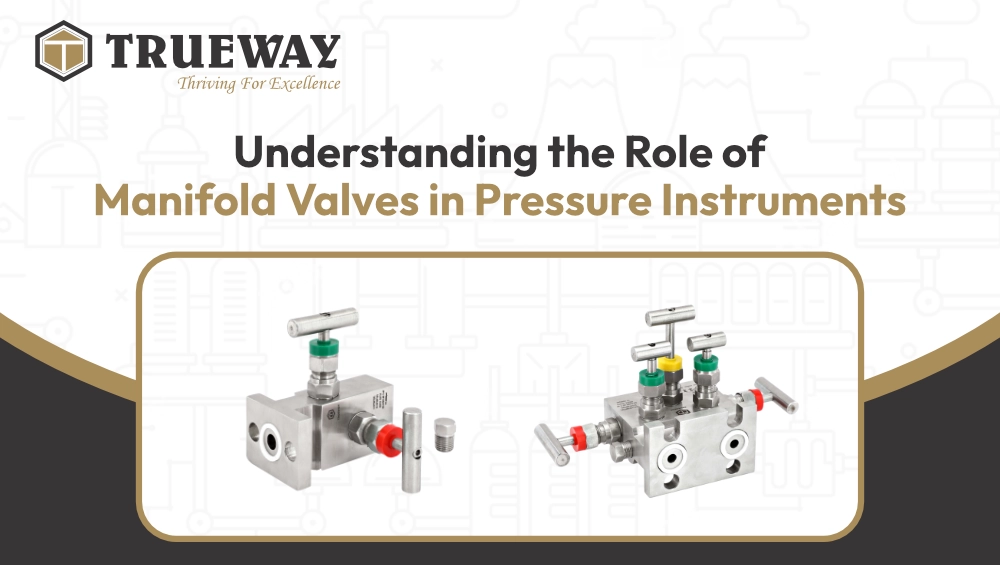
Proper pressure measurement contributes to safety, efficiency, and reliability across industrial processes. Pressure instruments need reliable connections that can handle process media without affecting measurement accuracy. A manifold valve provides a compact connection arrangement with functions such as isolation, equalization, venting, and maintenance support.
What Is the Role of a Manifold Valve?
A manifold is an assembly of multiple valves that connects pressure instruments to the process piping in an instrumentation system. The configuration may provide isolation and equalization of process pressure, and/or venting and/or bleeding for testing, calibration, and maintenance. This allows access to the instrument for servicing and simplifies connection to process piping.
What Is a Manifold Valve?
A manifold valve is a combination of multiple valves that connects process lines to pressure instruments. It can provide functions like isolation, equalization, and venting/bleeding. The required configuration depends on the instrument it connects to and the procedure for maintenance.
How Do Manifold Valves Work in Pressure Instruments?
In normal operation, the instrument is connected to the process through the manifold. When the instrument needs to be serviced, the valves on the manifold are operated to isolate the instrument from the process.
Equalize Pressure Across Connections
The manifold can also be used to equalize the pressure across the instrument connections. Isolation of the valves allows any pressure that is trapped to be bled or vented out through the appropriate connection prior to testing, calibration, or instrument removal.
Manifolds and Differential-Pressure Transmitters
Differential-pressure transmitters are of particular interest with regard to manifolds since they are high/low pressure connections. Three- and five-valve arrangements can provide isolation and equalization, and also be designed to include venting or testing, dependent upon the configuration.
They can be used to support a number of activities including zero checks, calibration, or other troubleshooting and maintenance activities.
Isolation and Equalization
- Isolation: Separates the instrument from the active process line for service or other maintenance activities.
- Equalization: Equalizes pressure at both connections of a differential pressure instrument.
- Venting/Bleeding: Provides a means to release process pressure prior to servicing or calibrating the instrument.
- Controlled Process Connection: Provides a controlled connection between process and the pressure instrument.
The manifolds valve provide a means to equalize pressure and to vent or bleed the process connection of the instrument, giving service personnel better control and simplifying the process.
Types of Manifold Valves
Trueway offers multiple manifold configurations for different pressure-instrument requirements, including:
Common types include:
- 2 Valve Manifold R Type (2VMR)
- 2 Valve Manifold T Type (2VMT)
- 3 Valve Manifold R Type (3VMR)
- 3 Valve Manifold T Type (3VMT)
- 5 Valve Manifold R Type (5VMR)
- 5 Valve Manifold T Type (5VMT)
- 3 Valve H Type (3VMH)
2-, 3-, and 5-Valve Manifold Comparison
Manifold Typical Functions Common Use
- 2-Valve Isolation/block and bleed or drain Basic pressure instrument isolation
- 3-Valve Two isolation/block functions and equalization Differential-pressure measurement
- 5-Valve Isolation, equalization, venting and testing functions DP transmitter calibration and maintenance
These are typical functional arrangements. The exact function and design can vary by manufacturer and product configuration.
Mounting Styles
Manifolds can be selected according to how the pressure instrument will be installed. Remote mounting allows the manifold and instrument to be positioned separately from the process connection, which can be useful where accessibility or installation conditions require it.
Instrument/transmitter mounting provides a compact arrangement directly with the connected pressure instrument. The choice depends on available space, accessibility, process conditions, and maintenance requirements.
How to Select the Appropriate Manifold Valve for Pressure Applications
- Test Pressure Up to 10,000 psi
- FPT Connections Generally 1/4"–1/2" NPT for listed transmitter-manifold configurations
- Other Threads BSPP, BSPT, ISO, Metric and other options on request
- Packing PTFE; Grafoil for high-temperature applications
The 10,000 psi figure is a catalogue-listed test pressure, not a universal operating-pressure rating. Always confirm the product-specific pressure and temperature limits before selection.
Materials Available
Trueway's listed manifold materials include SS316, SS304, Brass, Alloy 400 (Monel), Alloy 600 (Inconel), C276 (Hastelloy), and PTFE. Material selection should be based on process media, operating temperature, pressure, corrosion conditions, and application requirements.
Applications of Manifold Valves
Manifold valves are used across industries where pressure measurement and instrumentation are essential, including:
- Oil & Gas: Pressure transmitters and process instrumentation
- Chemical & Petrochemical: Process pressure measurement
- Power: Pressure monitoring in process and utility systems
- Pharmaceutical: Controlled process instrumentation
- Other Process Industries: Pressure and differential-pressure applications
Benefits of Manifold Valves
Manifold valves can provide several practical benefits for pressure-instrument installations:
- Compact installation with multiple functions in one assembly
- Fewer external connections, helping simplify installation
- Easier instrument isolation during maintenance
- Space efficiency in confined instrumentation areas
How to Select the Right Manifold Valve
Other important factors that have to be considered while selecting a manifold valve include:
Consider:
- Instrument type: Pressure gauge, pressure transmitter, or DP transmitter
- Manifold configuration: 2-, 3-, or 5-valve arrangement
- Pressure and temperature: Required operating and test conditions
- Process media: Fluid characteristics and compatibility
- Material: Appropriate construction material for the process
- Connection/thread: NPT, BSPP, BSPT, ISO, metric, other alternatives
- Mounting: Remote, transmitter mounting
- Vent/drain: Bleeding, venting, drain
- Maintenance: Calibration, zero checks, testing and servicing
A reliable manifold valve manufacturer in India should also provide applicable specifications and quality documentation to support the selection.
Additional Manifold Configurations
Some other options available are 5 Valve H Type Manifold Valves, Coplanar Manifold Valves, Block & Bleed Manifold Valves, and Bleed Plugs. These are of critical help in meeting isolation and instrument connection requirements for a given installation. Permanent and product marking, together with heat and lot-number traceability, assist in product identification and traceability during procurement, storage, and installation. Experienced manifold valve manufacturers in India make selection of technical products easy.
FAQ’s
What is an instrumentation manifold?
An instrumentation manifold is a multi-valve assembly which connects pressure instruments to process piping and may offer functions like isolation, equalization, venting and/or bleeding.
What is the function of a manifold with a pressure transmitter?
A manifold provides controlled connection, isolation, and maintenance access to the pressure transmitter. Depending on the configuration, it may provide venting and calibration.
What is the difference between 2-, 3-, and 5-valve manifolds?
A 2-valve manifold provides isolation and bleeding, a 3-valve manifold provides equalization, and a 5-valve manifold provides isolation and equalization plus venting and additional testing functions.
Why 3- and 5-valve manifolds with DP transmitters?
They allow the high- and low- pressure sides of a DP transmitter to be isolated and equalized. Five-valve configurations may provide venting and/or testing functions during calibration and maintenance.
What is the difference between remote and transmitter mounting?
Remote mounting separates the manifold and instrument from the process connection. Transmitter mounting provides a more compact arrangement, with the pressure instrument and transmitter mounted together.
What should be considered when selecting a manifold?
The type of instrument, configuration, and the pressure and temperature, as well as the process media, the material and the thread, the mounting arrangement and the vent/drain, and whether maintenance or calibration is required.
What pressure, materials, and threads are available?
Trueway's manifolds are available in SS316, SS304, Brass, Alloy 400, Alloy 600, C276, and PTFE. In the configurations listed, the test pressure is 10,000 psi, and NPT thread is available, with other thread options on other products.
Conclusion
Manifold valves provide equalization, isolation, and venting for pressure instrument connections. Manifold valves may also be used to control the process. The configuration depends on the process conditions, the instrument, mounting arrangement, and the maintenance requirements.
A reliable manifold valve supplier offers configurations of 2-, 3-, and 5-valve manifolds as well as H-type, coplanar, and block-and-bleed manifolds. With various materials, thread options, and testing, as well as traceability, the product line is able to support several pressure instrument applications.
Need reliable manifold valves for pressure instruments? Trueway offers quality solutions built for dependable performance. Get in touch today!