

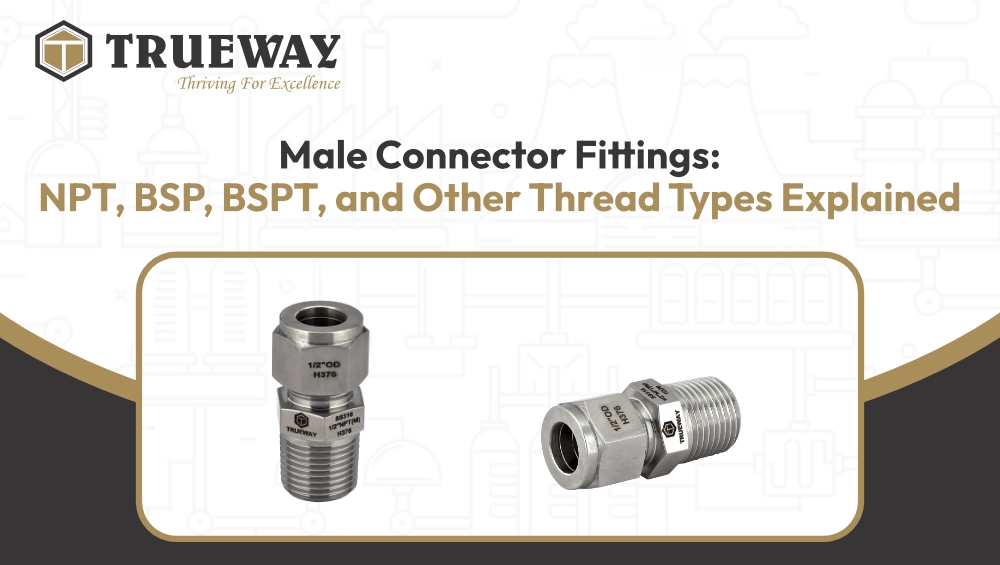
Male connector fittings are used in fluid and gas systems to connect pipes, tubes and hoses to ports on valves, manifolds, equipment and other system components. They feature external threads that fit into a compatible female port or fitting. While their primary function is to establish a secure connection, the thread type plays a critical role in determining compatibility, sealing requirements and leak prevention. Common thread standards include NPT, BSP, BSPT, ISO and SAE, each with specific designs and applications. Understanding these differences helps you select the right male connector, match it with the correct female connection and support reliable system performance.
What Is a Male Connector Fitting?
A male connector fitting has external threads designed to connect with a compatible female threaded port or fitting. It can link pipes, tubes or hoses to ports on valves, manifolds, machinery and other equipment. The connector helps create a secure connection, but the thread standard and sealing arrangement must match the female port to prevent leaks and thread damage. Male connector fittings may be manufactured from stainless steel, Monel, Inconel, Hastelloy, brass, PTFE and other materials, depending on the application's pressure, temperature, fluid compatibility and operating conditions.
Why Thread Types Matter in Male Connector Fittings
Thread specifications determine how two components fit together and how the connection is sealed. Choosing the wrong thread type can cause poor engagement, leakage, damaged threads, unreliable assembly or equipment failure. Selecting a compatible male connector and female port is therefore essential for safe and dependable operation.
Several factors affect thread compatibility and sealing, including thread angle, pitch, diameter, and whether the thread is parallel or tapered. The sealing method is equally important. Some compatible tapered threads seal through thread interference with a suitable sealant where specified, while many parallel-thread connections rely on an O-ring, bonded washer or metal sealing face. Always identify the connection standard and sealing design rather than relying on nominal size alone.
Understanding NPT, BSP, BSPT, ISO & SAE Thread Types
NPT (National Pipe Taper)
NPT (National Pipe Taper) threads are widely used in piping and fluid systems in North America. They have tapered threads and a 60-degree thread angle. As compatible male and female threads tighten, the taper creates an interference fit. A suitable thread sealant is commonly used when specified by the fitting manufacturer. The correct size and specification should be confirmed before installation.
BSP (British Standard Pipe)
BSP (British Standard Pipe) is a family of pipe threads available in parallel and tapered forms. BSPP refers to parallel threads, commonly designated by G under ISO 228-1. BSPP threads generally do not create the pressure seal by the threads alone; sealing usually depends on a washer, O-ring or another specified sealing face. Check the port and fitting design to confirm the required sealing method.
BSPT (British Standard Pipe Taper)
BSPT (British Standard Pipe Taper) uses tapered threads with a 55-degree thread angle and is associated with ISO 7-1 specifications. Depending on the connection design, the joint seals through compatible thread engagement, usually with a suitable sealant where specified. BSPT and NPT have different thread profiles and should not be assumed to be interchangeable.
SAE Thread Types
SAE standards cover several connection designs used in hydraulic and industrial systems. SAE straight-thread O-ring boss connections use straight threads, with an O-ring providing the seal. SAE J514 also covers 37-degree flare connections commonly associated with JIC fittings. Because SAE includes different connection styles, confirm the precise connection type, size and sealing method before matching components.
NPT vs BSP vs BSPT: Key Differences
| Thread type | Thread design | Typical sealing method | Common use |
|---|---|---|---|
| NPT | Tapered, 60° profile | Thread sealant as specified | North American piping |
| BSP | Parallel, 55° profile | Washer, O-ring or face seal | Industrial pipe connections |
| BSPT | Tapered, 55° profile | Thread engagement and suitable sealant | Pipe and fluid systems |
How Male Connector Fitting Threads Affect Sealing
Thread geometry determines how a male connector engages with its female port, but the threads do not always provide the seal by themselves. Compatible tapered connections may seal through thread interference, often with a suitable sealant where specified. Parallel-thread connections typically require a separate sealing element, such as an O-ring or washer, or a designated sealing face.
Incorrect thread matching, excessive tightening, damaged threads or an unsuitable sealant can compromise the connection and lead to leaks or component damage. Follow the manufacturer's installation instructions and confirm the pressure and temperature ratings of the complete assembly.
Are NPT and BSP Threads Interchangeable?
No. NPT and BSP threads should not be treated as interchangeable, even when their nominal sizes appear similar. NPT uses a 60-degree thread angle, while BSP uses a 55-degree profile. Thread pitch and diameter may also differ, affecting fit and sealing.
Trying to join incompatible NPT and BSP threads can damage the threads or produce an unreliable seal. Use an adapter specifically rated and designed to connect the two thread systems, and verify its size, material, pressure rating and sealing requirements.
How to Choose the Right Thread Type for a Male Connector Fitting
Before selecting a male connector fitting, check the equipment manufacturer's documentation and confirm the thread standard and size of the female port. Consider these factors:
- Operating conditions: Check the system's pressure, temperature and fluid compatibility.
- Thread measurements: Verify the thread's outside diameter, pitch and profile, using suitable measuring tools or gauges.
- Sealing arrangement: Confirm whether the connection requires thread sealant, an O-ring, a washer or a metal sealing face.
- Material requirements: Choose a material with suitable corrosion resistance and compatibility with the fluid and operating environment.
- System compatibility: Ensure the male connector matches the female port, equipment requirements and applicable specifications.
Common Applications of Male Connector Fittings
Male connector fittings are used in hydraulic power units, pneumatic machinery, instrumentation panels, industrial pipelines, compressors and fluid-transfer equipment. They connect pipes, tubes or hoses to ports on valves, manifolds valves, machines and other system components across manufacturing, automotive, energy and process industries. The appropriate thread type and material depend on the equipment design, operating conditions and technical requirements.
How to Identify the Correct Male Connector Fitting Thread
Start by checking equipment documentation, fitting markings or the manufacturer's catalogue for the specified thread type. If the information is unavailable, measure the thread's outside diameter and pitch with suitable tools. Check whether the thread is parallel or tapered, and use a thread gauge where needed to help identify the profile. If identification remains uncertain, consult the equipment or fitting manufacturer before connecting the parts.
Contact Trueway to discuss male connector fittings that match your system's thread type, material and sealing requirements.
FAQ’s
What is the difference between NPT and BSP threads?
NPT has a tapered design and a 60-degree thread angle. BSP uses a 55-degree profile and includes both parallel (BSPP) and tapered (BSPT) forms. Their dimensions and sealing methods differ, so the exact thread standard should be confirmed before connecting fittings.
Which Male Connector Thread Type Is Best for High-Pressure Applications?
There is no single thread type that is best for every high-pressure application. Selection depends on the system design, specified pressure and temperature ratings, fluid compatibility, connection type and sealing method. Follow the equipment manufacturer's specifications and applicable standards.
How Do You Connect Fittings with Different Thread Types?
Use an adapter specifically designed for the two thread systems. Before installation, confirm the thread sizes, material compatibility, pressure rating and sealing requirements for the adapter and the complete assembly.
Do Male Connector Fittings Require Thread Sealant?
Not always. Tapered pipe threads may require a suitable thread sealant, while parallel-thread connections that use O-rings, washers or sealing faces rely on those sealing elements. Follow the manufacturer's instructions for the specific fitting and application.