

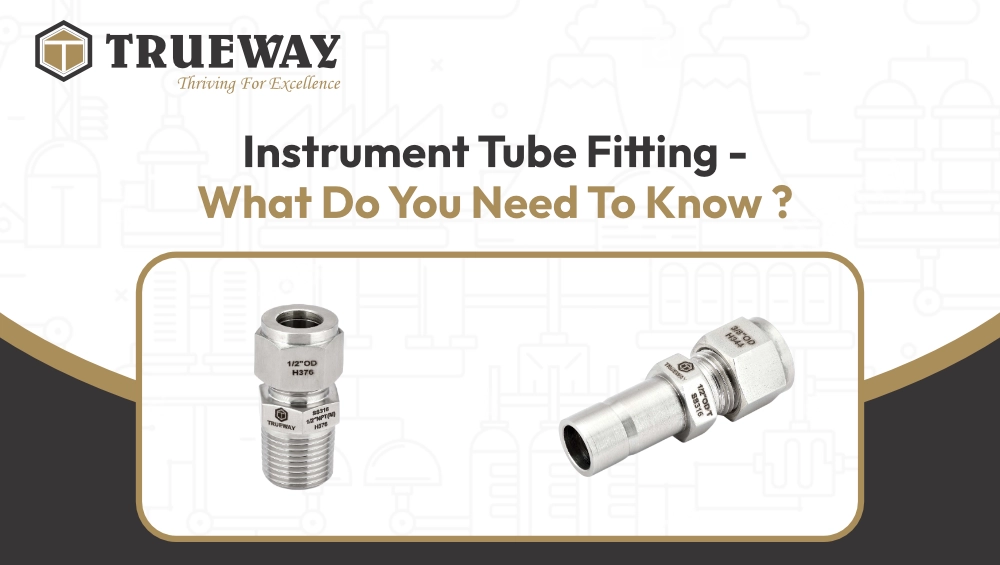
In industrial fluid and gas systems, connections are critical failure points. Instrument tube fittings provide leak-tight connections in high-pressure environments in different industries such as oil and gas, chemical processing, power generation, pharmaceutical, Fertilizers, and Steel Plant. These precision-engineered components can handle extreme pressures, corrosive media, temperature variations, and continuous vibration.
Trueway, a leading Instrumentation Tube Fittings Manufacturer, specializes in double ferrule compression-type fittings delivering zero-leak performance. A good understanding of tube fittings and their selection helps professionals avoid any system failures.
What Is an Instrument Tube Fitting?
An instrument tube fitting is a mechanical component that creates secure, leak-tight connections between tubes or between tubes and instruments in fluid and gas handling systems.
These fittings help in controlling pressure, temperature, and flow accurately. They resist mechanical vibration, corrosive environments, and high-pressure conditions without compromising seal integrity.
Types of Instrument Tube Fittings
Different types of tube fittings address specific application requirements, pressure ratings, and installation conditions.
- Compression Fittings (Single & Double Ferrule) – Provide leak-tight, weld-free joints through mechanical compression of ferrules. Double ferrule designs offer excellent sealing and vibration resistance for high-pressure instrumentation.
- Bite-Type Fittings – Ferrule "bites" into tube OD, creating a mechanical grip for vibration-resistant connections in hydraulic and pneumatic systems.
- Flare Fittings – Tube ends flared at 37° or 45° create cone-shaped sealing surfaces for high-pressure hydraulic systems, aircraft fuel lines, and refrigeration applications.
- Threaded Tube Fittings – Use male/female pipe threads (NPT, BSPP, BSPT, ISO, metric) sealed with PTFE tape, liquid sealants or rubber gasket/ O-Ring.
- Welded Tube Fittings – Permanently joined through Argon welding for Higher Size & for handling hazardous media.
- Push-to-Connect (Quick Connect) – Tool-free connections using internal gripping mechanisms for pneumatic circuits and low-pressure systems.
Key Components of Instrument Tube Fittings
Each component has a specific role in the proper installation and maintenance of tube connections.
- Body – Main structural component with precision-machined cone seats, thread profiles, and port configurations.
- Ferrules (Front & Back Ferrule) – Front ferrule creates a metal-to-metal seal with the body's cone seat; back ferrule grips the tube OD, providing axial support for gas-tight seals under pressure pulsations.
- Nut – Provides mechanical force to compress ferrules onto the tube. Proper tightening prevents leaks or thread damage.
- Tube – Conduit for fluid or gas flow, selected for material compatibility, wall thickness, and OD matching fitting size.
Selection Considerations for Tube Fittings
- Compatibility with Pressure and Temperature Ratings – Fittings must handle maximum operating pressure, including surges (0-6000 psi) and extremes temperature.
- Material Selection – SS304/SS316 for general corrosion resistance, , High Nickel Alloys for highly corrosive media/ Atmosphere, brass for water/air.
- Size and Thread Type – Match tube OD precisely (1/16" to 2" OD fractional; 3mm to 38mm metric) and thread types (NPT, BSPP, BSPT, ISO, metric).
- Corrosion Resistance – Material selection extend fitting life in harsh environments.
- Reliability of Manufacturer and Certifications – Instrumentation tube fittings manufacturer must follow such as specification as ASTM F1387, ISO, and ASME. Also check for test reports, pressure certificates, and traceability documentation.
Practical Applications of Instrument Tube Fittings
Tube fittings serve critical roles in the following industries:
- Fertilizer Plants – Used in ammonia, urea, nitric acid, and phosphoric acid systems within high-pressure reactors.
- Oil & Gas Industry – Essential for wellhead control, offshore platforms, refineries, and pipelines handling crude, gas, and refined products.
- Pharmaceutical Manufacturing – Provide hygienic, sterile connections for API production, formulation, CIP systems, and bioprocessing with electropolished finishes.
- Chemical & Petrochemical Plants – Manage corrosive acids, bases, and solvents in reactors, distillation, and sampling under high pressure and temperature.
- Power Generation – Support steam, feedwater, and condensate circuits in thermal, nuclear, and combined cycle plants, plus turbine instrumentation.
- Water & Wastewater Treatment – Used in pH, flow, and pressure monitoring and chemical dosing in municipal and industrial systems.
- Food & Beverage Processing – Sanitary stainless steel for dairy, brewing, and food lines.
- Aerospace & Defense – Applied in hydraulics, fuel, and environmental control systems.
- Railways- For hydraulic & Pneumatics pressure lines.
What Makes Trueway the Best Instrumentation Tube Fittings Manufacturer?
- Comprehensive Range– We offer complete product lines including connectors, elbows, tees, crosses, bulkhead unions, reducers in Vast range of sizes.
- Quality Assurance and Compliance– Material test reports & pressure testing with complete traceability. Fittings type tested as per ASTM F 1387.
- Precision Engineered Tube Fittings– Double ferrule compression design with precision-machined cone seats and silver-plated nuts for zero-leak performance up to 10,000 psi.
- Custom Sizes and Materials – We use SS304, SS316, Brass, Monel, Inconel, Hastelloy and PTFE to manufacture tube fittings with custom dimensions and thread types.
- Fair Prices– Transparent pricing based on material grade, size, quantity, and delivery requirements.
Conclusion
Proper fitting selection prevents failures, safety incidents, and environmental releases. Partnering with a trusted Instrumentation Tube Fittings Manufacturer like Trueway provides precision-engineered products backed by quality certifications and proven reliability.
Ready to discuss your tube fitting requirements? Contact Trueway today at +91 90041 46034 +91 93217 56212 for expert guidance and quality solutions.
What is an instrument tube fitting?
A mechanical component creating leak-tight connections between tubes or instruments for controlled fluid/gas transfer. This helps in maintaining pressure integrity and flow regulation in industrial systems.
What are the different types of tube fittings used in instrumentation?
Compression (single/double ferrule), flare (37°/45°), bite-type, threaded (NPT/BSPP/BSPT), welded for high-pressure permanent connections, and push-to-connect for tool-free applications.
What materials are instrument tube fittings made from?
Stainless steel (SS304, SS316), brass, Monel, Inconel, Hastelloy, and PTFE are selected based on corrosion resistance, temperature requirements, and chemical compatibility.
How do I choose the right tube fitting for my system?
You should match pressure/temperature ratings, verify media compatibility with material, confirm tube OD and thread type, and assess corrosion factors. You should also check manufacturer certifications.
What industries commonly use instrumentation tube fittings?
Oil and gas, chemical and petrochemical, pharmaceutical, fertilizer production, power generation, water treatment, food and beverage, Defence, Railways and industrial instrumentation.
How can I get leak-free installation of instrument tube fittings?
Follow tightening specifications, use square-cut deburred tube ends, verify tube OD, apply 1-1/4 turns past finger-tight for double ferrule, avoid tube twist, and pressure test post-installation.
Why is it important to buy from a reliable Instrumentation Tube Fittings Manufacturer?
Provides consistent quality, dimensional accuracy, material certifications, standards compliance (ASTM, ISO), technical support, documentation, and proven reliability preventing failures.
Can instrument tube fittings be reused?
Yes, if ferrules and tube show no damage, corrosion, or excessive deformation. Inspect components, replace questionable ferrules, apply proper torque, and pressure test before service.
What are the signs that a tube fitting needs replacement?
Visible leakage, corrosion or pitting, thread damage, body cracks, tube scoring at ferrule contact, connections that won't tighten properly, or fittings exceeding service life limits.